



The Hidden Health Impact of K–12 Restroom Design

Imagine that at your job, there is a room you need to use to be an effective and healthy employee. But it is frequently crowded, often loud, and sometimes unsafe. You might encounter smoking or vaping, vandalism, or fighting in this space. You may be bullied or challenged by others simply for being there, even when keeping to yourself. This room is only checked on occasionally, creating an area that is unsupervised and out of sight.
The result is simple: you can’t do your job effectively.
Avoidance
This scenario is an analogy for student restrooms in K–12 schools. As students progress from elementary to middle and high school, barriers to restroom use increase. Traditional, gender‑segregated restrooms are often out of the direct view of staff and present supervision challenges when staff access is limited by gender. With less supervision, negative behaviors such as fighting, smoking, graffiti, and bullying are more likely to occur, creating environments that feel unsafe for students.
As a result, most middle and high schools have at least one restroom that is always closed or locked due to these behaviors. In addition to safety and privacy concerns, limited supervision can contribute to maintenance challenges, leading to cleanliness and odor issues. Together, these conditions lead many students to avoid using restrooms during the school day.
A student’s ability to focus on schoolwork, feel confident among their peers, and exhibit positive mental health is closely tied to physical wellness. However, the link between student restroom use, physical health, and academic performance has largely been overlooked.
Methods and Research Approach
To better understand the connection between physical wellness and student success, we applied a multi‑layered research approach. Our work included a review of scholarly literature, a large student survey, and an observation day at a high school where single‑user, universal restrooms had opened within the past year.
By gathering insights from students and staff through dozens of interviews, we were able to do what is imperative as education designers: to learn from the spaces we design.
Research on Student Physical Wellness and Restrooms
Beginning in first grade, access to restrooms becomes increasingly restricted as students advance through their school careers. Research shows that negative impressions of school restrooms increase with age and grade level, contributing to avoidance as a learned behavior (Lundblad & Hellstrom, 2005; Kistner, 2009). Studies have found that some students avoid school restrooms for extended periods due to concerns about bullying, lack of privacy, unpleasant odors or cleanliness, and the behavior of other students (Norling et al., 2016; Kistner, 2009; Bradley Company, 2024).
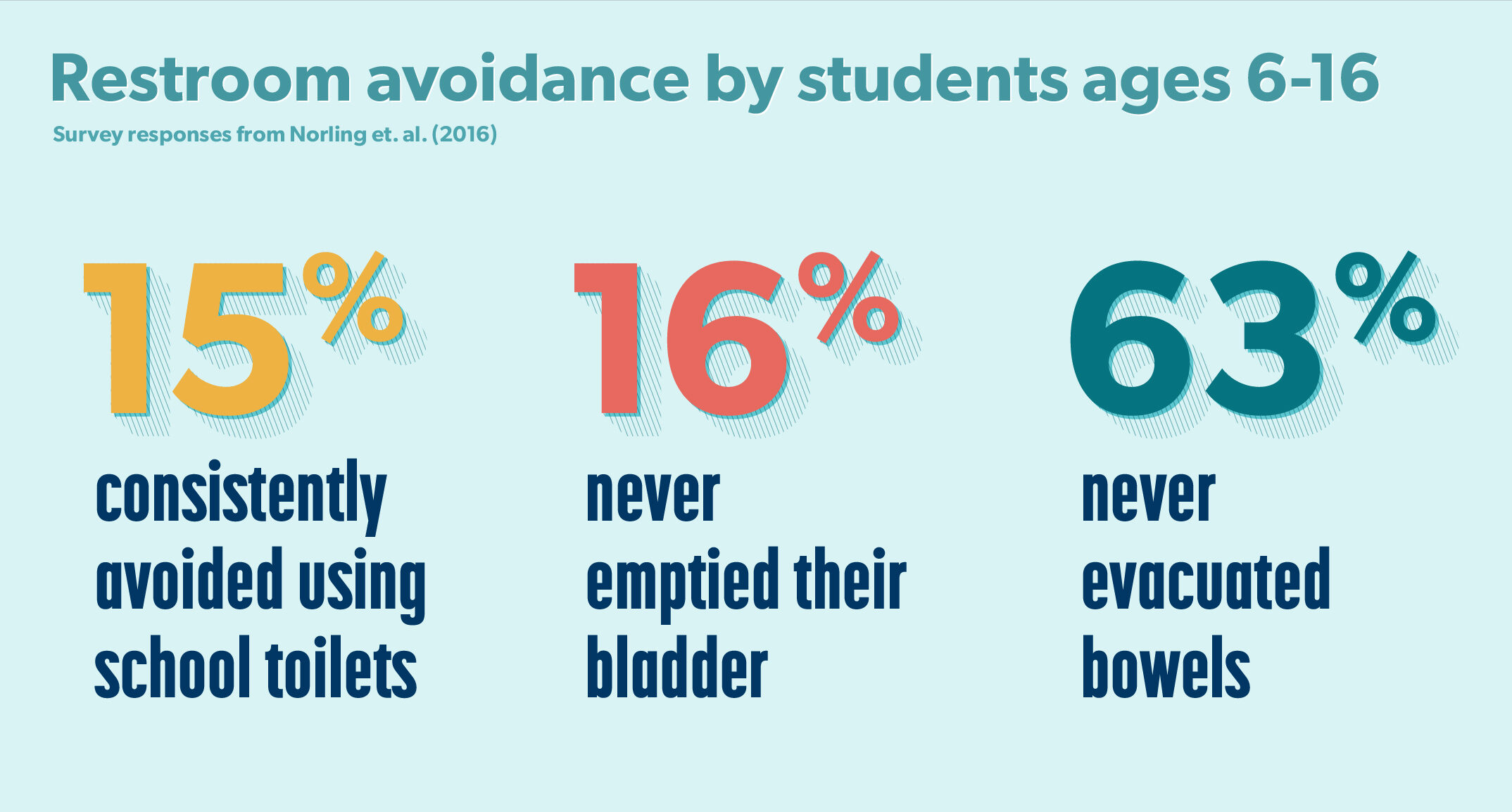
Avoidance and withholding behaviors can have significant physiological consequences. Some students report going an entire school day—up to eight or nine hours—without using the restroom. Frequent withholding can lead to complications with the bladder and bowel systems, including symptoms of dysfunctional elimination syndrome (DES), such as incontinence, recurring urinary tract infections (UTIs), and vesicoureteral reflux (VUR) (Kistner, 2009). When these conditions persist, they may extend into adulthood, with childhood experiences of DES linked to long‑term bladder and renal issues (Norling et al., 2016; Shoham et al., 2021).
Beyond physical health impacts, restroom avoidance also affects students’ ability to learn. Discomfort and stress can impair concentration and focus, while school routines often limit opportunities to use restrooms during less crowded times. Research suggests that students may intentionally try to use restrooms during class rather than passing periods to avoid exposure or interaction with peers, though classroom restrictions frequently prevent this (Lundblad et al., 2010). As a result, students may delay restroom use, leave campus to find alternative facilities, or miss instructional time altogether. In response, schools sometimes further restrict access due to concerns about supervision or vandalism, reinforcing a cycle of avoidance throughout the school day (Norling et al., 2016).
Results of Student Feedback Survey, Interviews, and Observations
The recent renovation and addition we designed at Graham-Kapowsin High School provided an ideal situation to gather student feedback about single-user restrooms. The addition added single-user, universal restrooms in one wing, while existing traditional gang-style restrooms were retained in other areas.
This allowed students to choose between the two restroom types and provided valuable insight into how design impacts use.
The post‑occupancy evaluation (POE) included a student survey with 928 respondents, onsite observations, and interviews with students and staff. During the observation day, we met with entire classes as well as students individually and in small groups, and spoke with staff, administrators, security, and maintenance personnel to better understand the broader restroom culture at the school.
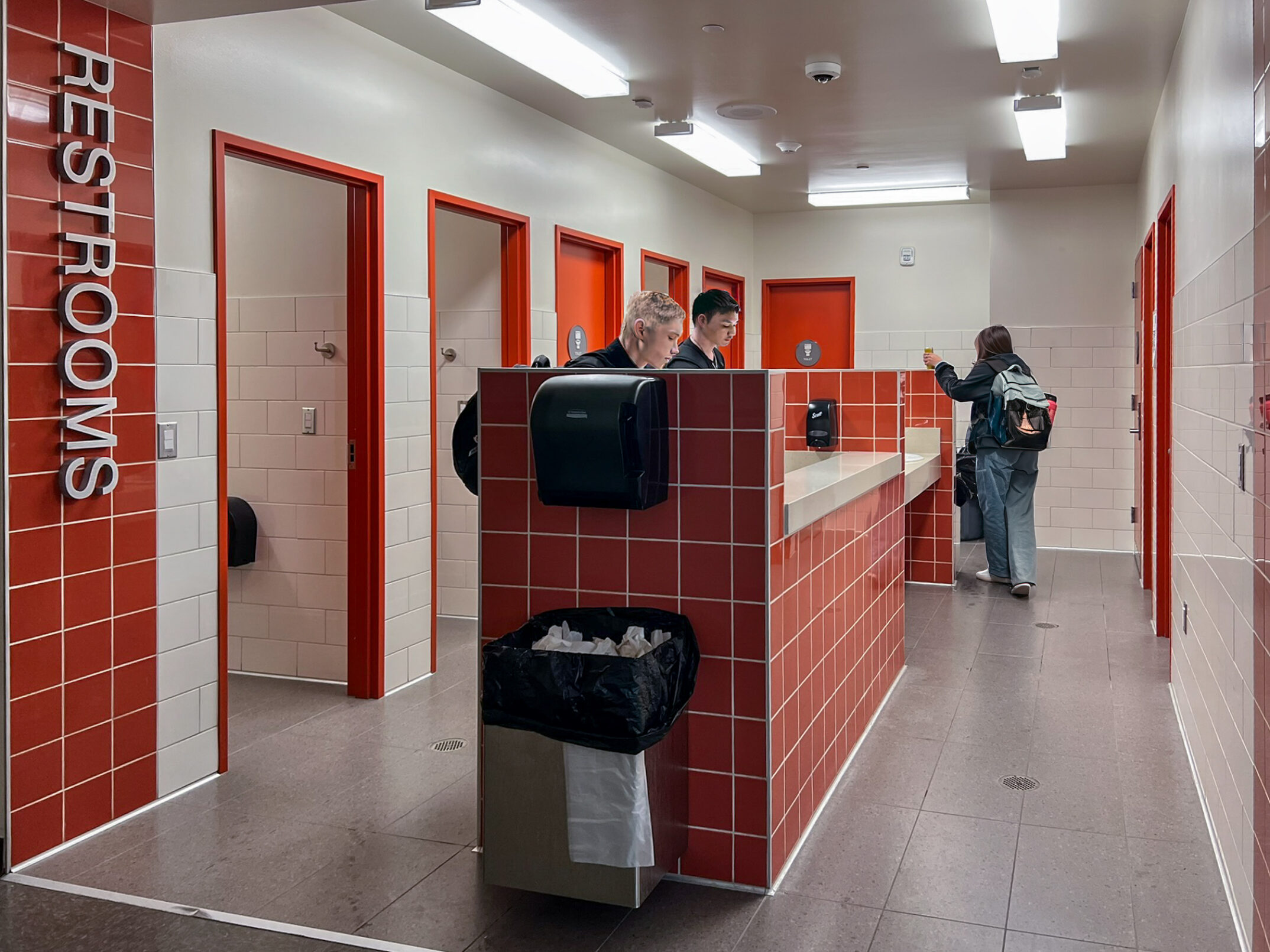
Single‑user restrooms at Graham‑Kapowsin High School are located off a main hallway in one wing, integrating universal access into daily student movement. Photo by NAC Architecture. Student figures shown have been altered for privacy and do not represent actual students.
Student Perspectives on Restroom Use
Across survey responses and in‑person conversations, students described restroom environments that often feel unsafe, uncomfortable, or difficult to use.
Safety and Peer Behavior
Students frequently cited negative behaviors—such as vaping, fighting, and large groups occupying restroom spaces—as major deterrents to use. In some cases, students described feeling unsafe when entering traditional gang‑style restrooms, particularly in boys’ restrooms, where physical altercations were reported.
Privacy and Exposure
Students described discomfort with being seen, judged, questioned, or interrupted while using the restroom. Many expressed a preference for single‑user restrooms because these spaces provided full enclosure, clearer boundaries, and greater personal privacy.
Supervision and Oversight
Students noted that traditional restrooms often lacked consistent supervision, contributing to unsafe conditions and increasing their desire for greater security presence near restrooms.
Willingness to Use and Avoidance
As a result of these combined factors, some students reported avoiding school restrooms altogether, while others limited their use to single‑user restrooms when available. Avoidance behaviors included holding throughout the school day or choosing not to use restrooms at school at all.
Staff Perspectives on Restroom Use and Operations
Staff observations reinforced many of the patterns described by students, while also highlighting the operational challenges associated with traditional restroom layouts.
Student Avoidance and Coping Behaviors
Staff reported that some students avoided using school restrooms altogether due to discomfort or lack of privacy. In response, students developed informal coping strategies such as delaying restroom use, seeking out less‑used facilities, or leaving campus to use restrooms elsewhere. These patterns underscored how strongly restroom design influenced students’ willingness to meet basic needs during the school day.
Supervision and Access Limitations
Staff described supervision challenges within traditional, gender‑segregated restrooms. Depending on staff gender, administrators and teachers were unable to enter restrooms to address unsafe or disruptive behavior.
Operational Workarounds
To accommodate students who were uncomfortable using traditional restrooms, staff sometimes relied on informal solutions such as providing access to staff restrooms or directing students to gym facilities with less use during passing periods.
Maintenance and Availability Outcomes
Staff also noted differences in availability between restroom types. Traditional restrooms were more likely to be closed due to vandalism or other issues, while single‑user restrooms remained consistently open.
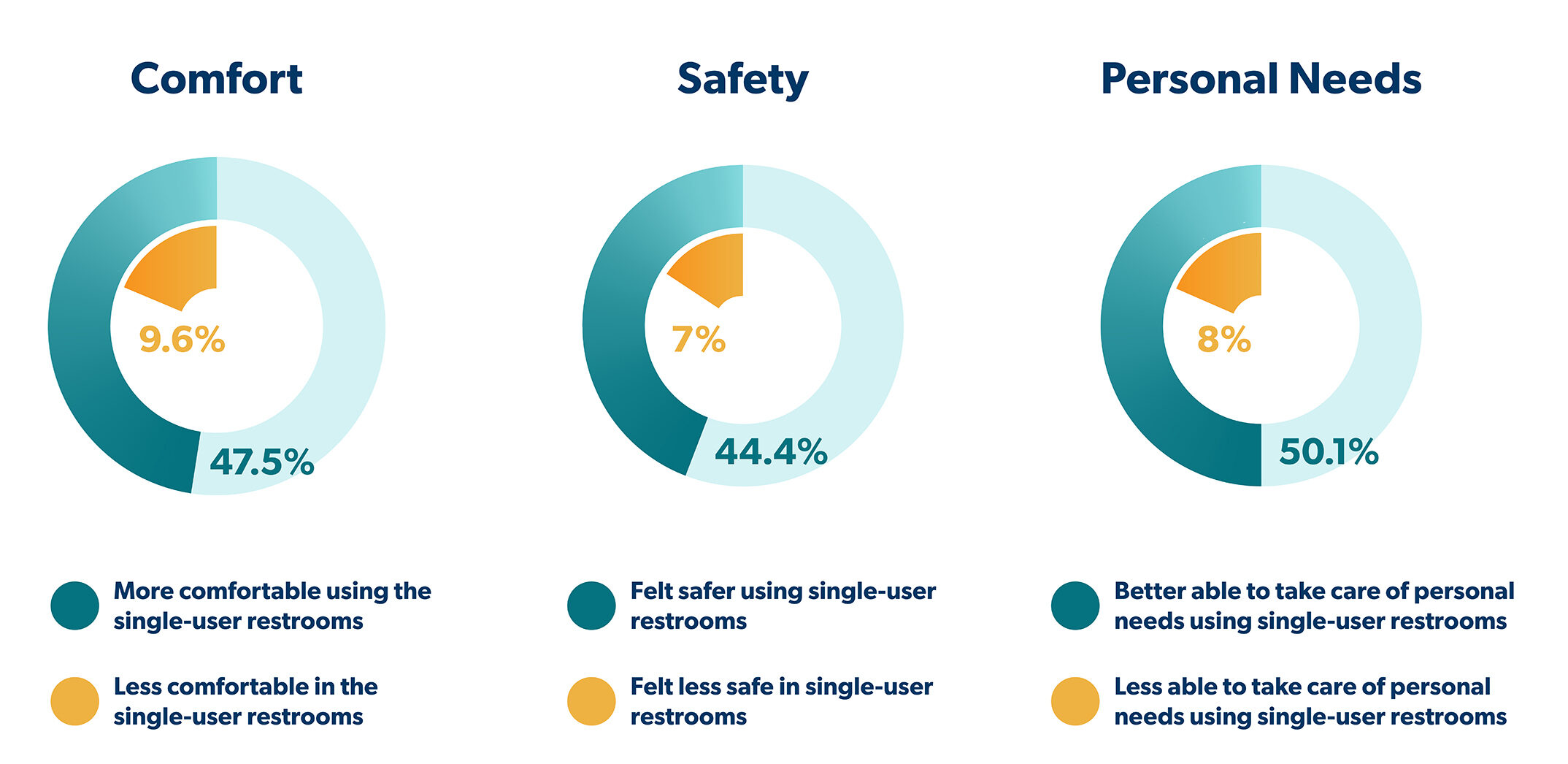
While single-user, universal restrooms can’t address all of the issues students cite as reasons they avoid going to the restroom at school, the results did show many students preferred the single-user restrooms instead of traditional restrooms. This preference aligns with students’ comments about the added privacy and security features offered by the single-user restrooms.
Design and Operational Lessons Learned
The research findings, survey results, and feedback from students and staff point to clear patterns in how restroom design influences student behavior, safety, and willingness to use these spaces. Increasing student restroom use is a critical outcome, supported by research documenting the negative short‑ and long‑term health effects of restroom avoidance.
Drawing from these insights, the following lessons highlight practical design and operational considerations for creating restroom environments that better support student health, safety, and day‑to‑day use.
Layout & Supervision
- Design restrooms to be as open and supervisable as possible, even at the high school level where students are more independent. Restroom entrances and doors should be visible from the corridor to support safety and oversight.
- Provide adequate queuing space in adjacent hallways to avoid awkward waiting conditions that can discourage use.
- Locate larger, accessible restrooms where supervision is strongest, as these spaces can still become gathering areas if not well monitored.
Fixtures & Hygiene
- Provide ample sinks, soap, paper towel dispensers, and trash receptacles. As restroom use increases, so does handwashing.
- Address sensory factors that contribute to avoidance, including odors, ventilation, and sufficient space to move comfortably.
- Include seat covers, feminine products, and small waste containers in each private toilet compartment to support convenience, privacy, and hygiene needs.
Hardware & Durability
- Specify durable, heavy‑use hardware, particularly for lock indicators, which experience frequent operation throughout the day.
- Use full‑height doors to enhance privacy, with minimal undercuts during use. Doors should not include closers, allowing them to remain open when unoccupied to support airflow.
Operations
- Even with improved visibility and design, some settings may require periodic adult supervision to support smooth flow and discourage extended occupancy.
- As restroom use increases, maintenance teams should plan for higher demand for cleaning, paper supplies, and routine upkeep. Student preference for single‑user restrooms means these spaces may experience heavier use and require more frequent maintenance.
Designing for Student Health and Dignity
Restroom use is a fundamental yet often overlooked aspect of student health and well‑being. Research and feedback from students and staff show that restroom avoidance is not limited to a small group of students, but occurs across grade levels and school types.
Single‑user restrooms provide the privacy, security, and predictability students need to feel comfortable using restrooms during the school day. Full‑privacy stalls and improved visibility support safer environments that are easier to supervise, helping address concerns related to bullying and other student conduct that often drive avoidance.
As educators and designers collaborate, there is an opportunity to apply these lessons more broadly. By listening to students, learning from post‑occupancy feedback, and refining designs over time, schools can create restroom environments that support physical health, mental well‑being, and dignity for all students.
References:
Chen, H.-S., Chiou, C.-J., & Sheu, J.-J. (2000). Postponed Bladder Emptying Among Elementary School Students. Journal of Nursing Scholarship, 32(2), 161–161. https://doi.org/10.1111/j.1547...
Kistner, M. (2009). Dysfunctional Elimination Behaviors and Associated Complications in School-Age Children. The Journal of School Nursing, 25(2), 108–116. https://doi.org/10.1177/105984...
Lundblad., B., & Hellström, A. (2005). Perceptions of school toilets as a cause for irregular toilet habits among schoolchildren aged 6 to 16 years. Journal of School Health. https://doi.org/10.1111/J.1746...
Lundblad, B., Hellström, A., & Berg, M. (2010). Children’s experiences of attitudes and rules for going to the toilet in school. Scandinavian Journal of Caring Sciences, 24(2), 219–223. Crossref. https://doi.org/10.1111/j.1471...
Norling, M., Stenzelius, K., Ekman, N., & Wennick, A. (2016). High School Students’ Experiences in School Toilets or Restrooms. The Journal of School Nursing, 32(3), 164–171. https://doi.org/10.1177/105984...
Shoham, D. A., Wang, Z., Lindberg, S., Chu, H., Brubaker, L., Brady, S. S., Coyne-Beasley, T., Fitzgerald, C. M., Gahagan, S., Harlow, B. L., Joinson, C., Low, L. K., Markland, A. D., Newman, D. K., Smith, A. L., Stapleton, A., Sutcliffe, S., & Berry, A. (2021). School Toileting Environment, Bullying, and Lower Urinary Tract Symptoms in a Population of Adolescent and Young Adult Girls: Preventing Lower Urinary Tract Symptoms Consortium Analysis of Avon Longitudinal Study of Parents and Children. Urology, 151, 86–93. https://doi.org/10.1016/j.urol...